
Tulum Ruins - Zama City of the Dawn

Updated: Feb 13, 2023
When traveling to Tulum, of course, the Tulum Ruins are a place you want to visit!
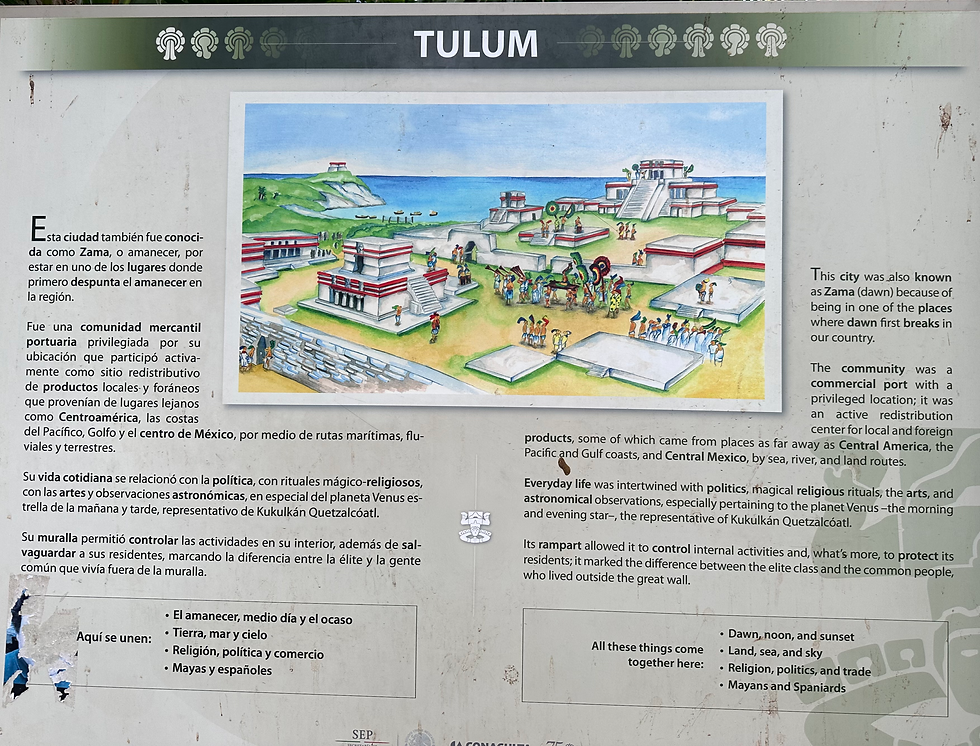
The ancient city is also called Zama, meaning City of Dawn, because it faces the sunrise.
Tulum is also the Mayan word for fence or wall. The walls surrounding the site allowed the Tulum fort to be defended against invasions. Tulum had access to both land and sea trade routes, making it an important trade hub, especially for Obsidian. Tulum is also highly connected with the planet Venus.
Compared to others, the Tulum Ruins are one of the smaller Mayan sites. However, the site is also one of the most beautiful, located on a cliff overlooking the Caribbean Sea.

Inside, you’ll find the Templo del Dios del Viento (Wind God Temple), the most famous of Tulum Ruins buildings. From there, continue onto the other buildings along the designated path. These include the Templo del Dios Descendente (Temple of the Descending God), El Castillo (The Castle), Templo de Los Frescos (Temple of the Frescoes) and La Casa De Cenote (The House of the Cenote). Shown below - but not in order mentioned!
It is not possible to climb the ruins here or visit the beach directly below anymore, but it’s important for us to honor and preserve these sacred ruins and the surrounding beach front!
This was my 3rd time visiting the Ruins over the last 10 years. Each time has been uniquely different. The first time was part of a tour that I took out of the Playa Del Carmen area to specifically visit Tulum and the Ruins. It was a guided tour and a nice experience. There were many families and it provided a well-organized platform for my family to experience the ruins.
The last two times, I have chosen to self-tour which has worked out great as I could take in each element on my own schedule, lingering here and there as called by the energies. There are markers at each of the ruins that guide you through and describe what you are looking at and the history of each building/area. It is inexpensive to enter the ruins and tickets may be purchased as you enter. One thing you will find are local tour guides that will approach you at the entry and ask if you would like to join their tour. I think there are 6-8 different languages available. While I have not done this, if I go through the ruins again, I will join a group with a guide. As long as you don’t mind being in a group or paying a little more for a private guide, it’s always nice to hear and learn from the added insight of a local guide! They don’t charge much and get you through the entry line more expeditiously!

Touring the ruins takes about 1-1/2 hours once you are inside. I highly recommend going earlier in the day before it gets too hot and crowded. Wear clothes appropriate for the weather! There is not much shade here, and while there can be a great breeze off the ocean, it can also be still and HOT in the sun! Sunscreen, a hat and plenty of water are a must! Of course, don’t forget your camera!
It is easy to get to the ruins with a quick taxi ride from the hotel zone and equally easy to get a return taxi at the exit. Don’t stress about transportation on your own! Many also rent bikes and ride to the ruins for the day. Personally, I would enjoy the bikes on a separate outing! When leaving the ruins if you are ready to explore a little more, there are public beaches you can experience very close by. Walk, bike or take a taxi to one. There is also a public bus system of vans - it's called “Collectivo”. It is more economical than a taxi and provides a different experience- this is also an option! Your hotel should be able to assist you with the schedule and routes! Be adventurous, follow your heart, and have fun!
Tip: If you find a taxi driver you really like, get his number on WhatsApp so you can reach out directly when you need rides! Most are happy to do this! You will want this App downloaded prior to your trip as it’s a great way to communicate when traveling internationally.
For those of you that are Earth Keepers and Grid Workers like me, or just love to connect to the land in new and different ways, I highly recommend one of my favorite artist's, Deya Dova. She travels the planetary grid working with the Earth and its elements, weaving and creating amazing light (language) music for all. This compilation is near and dear to my heart, soul and this land...
Learn more about her and have a listen here: https://deyadova.com/the-creation-codex/
She will take you deep into all that is...
Feel into the energies of this beautiful ancient city, imagine living in those times, and enjoy!
Blessings and Love,
Kelly
Reference:

There is something approachable about discussing choosing books for a varied reading collection through situations people can actually picture. A balanced collection can include familiar interests and a few titles that invite something new. It also gives the phrase book selection ideas a clearer meaning than a label on its own. The part I would like to explore further is what happens when the idea meets a real situation with its own limitations. How do you choose books for readers with very different tastes?
What draws my attention to building everyday cybersecurity awareness is the possibility of making an unfamiliar subject feel closer to everyday life. Recognising an unexpected message is a useful first step before deciding whether to trust it. I would use that point as a starting question when considering cybersecurity awareness basics. I would probably come back to this question after trying to work through one concrete example rather than deciding immediately. Which examples make online safety lessons memorable for beginners?
I can see why turning personal goals into manageable steps would invite discussion, since different people will bring different experiences to the same question. A large ambition can feel more approachable when the next step is small and specific. For me, that is a useful way into the broader subject of personal goal planning. I would probably come back to this question after trying to work through one concrete example rather than deciding immediately. How would you recognise progress before reaching the final goal?
When it comes to building confidence in everyday communication, I would rather understand one useful detail properly than rush through a long list of ideas. Practising a small conversation can make speaking up feel more manageable. It also gives the phrase communication confidence a clearer meaning than a label on its own. A short discussion of an everyday example would make this easier for me to connect with, especially as someone still learning about the subject. Which low-pressure activities help someone become more comfortable expressing an idea?
A conversation about planning the next step in graduate education seems most useful to me when it leaves space for uncertainty and further questions. A clear research interest can make a programme comparison more meaningful than a list of rankings. It makes me curious about the practical side of graduate study planning. I would probably come back to this question after trying to work through one concrete example rather than deciding immediately. What would help you decide whether a programme fits your learning goals?